
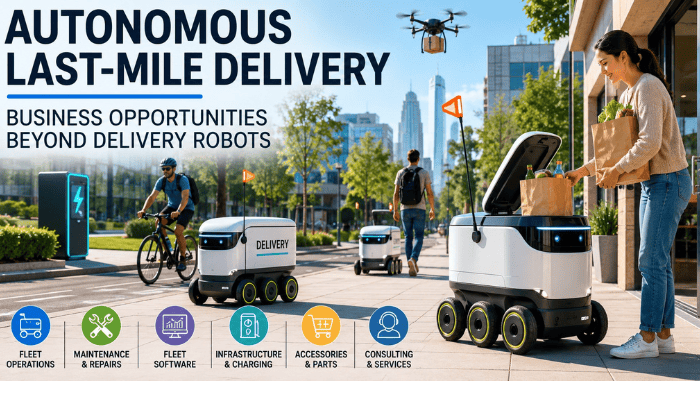
Autonomous Last-Mile Delivery refers to the use of robots, autonomous vehicles, and AI-powered systems to transport goods from local distribution hubs directly to customers.
While much of the current focus is on the robots themselves, the long-term opportunity could extend far beyond autonomous deliveries. As adoption grows, an entire ecosystem of supporting businesses, software platforms, infrastructure, maintenance services, and specialist suppliers is likely to emerge.
For entrepreneurs, this creates opportunities to build businesses that support the industry rather than directly compete with companies developing autonomous delivery technology.
Why It’s Growing 📈
Governments in several countries are exploring or updating regulations to support autonomous delivery technologies. As legal frameworks mature, delivery robots are expected to become increasingly common in urban environments, business parks, university campuses, and residential developments.
Several long-term trends are accelerating investment in autonomous last-mile delivery:
- Advances in AI, robotics and machine learning
- Rising labour costs
- Growth of ecommerce and on-demand delivery
- Demand for faster local deliveries
- Labour shortages across logistics industries
- Improvements in battery technology
- Increasing investment from retailers and logistics companies
- Regulatory developments supporting autonomous transport
Rather than replacing human delivery drivers entirely, autonomous delivery is more likely to complement existing logistics networks by handling short-distance, lower-cost deliveries where automation offers clear advantages.
Although widespread adoption is still in its early stages, the market is moving steadily towards greater automation.
Target Customers 🎯
Primary Customers
- Logistics companies
- Retailers
- Supermarkets
- Restaurants
- Pharmacies
- Courier companies
- Universities
- Hospital campuses
- Takeaway and fast food outlets
Secondary Customers
- Local authorities
- Property developers
- Business parks
- Industrial estates
- Smart city initiatives
Emerging Ecosystem 🌍
Autonomous last-mile delivery is likely to create opportunities far beyond the robots themselves. As the industry develops, businesses may emerge across software, infrastructure, maintenance, specialist equipment, and supporting services.
Areas worth watching include:
- Delivery robots
- Fleet management & analytics software
- Charging infrastructure
- Robot maintenance & servicing
- Navigation & mapping software
- Battery technologies
- Smart delivery lockers
- Cargo modules
- Remote monitoring systems
These supporting technologies and services could offer multiple entry points into the industry without requiring businesses to develop autonomous robots themselves.
Business Opportunities
Local Robot Fleet Operator – Top Pick 🥇
Rather than manufacturing autonomous robots, operate local delivery fleets on behalf of retailers, restaurants, pharmacies, and supermarkets.
Similar to today’s courier companies, operators could own or lease fleets of autonomous delivery robots and provide delivery services to multiple local businesses.
Revenue could come from:
- Per-delivery charges
- Monthly contracts
- Managed delivery services
This represents one of the most accessible ways for entrepreneurs to participate in the industry without developing autonomous technology themselves.
Opportunity Rating: 9/10
Robot Maintenance & Servicing 🥈
Every autonomous fleet will require ongoing servicing.
Potential services include:
- Battery replacement
- Sensor calibration
- Cleaning
- Repairs
- Preventative maintenance
- Software diagnostics and updates
As fleets become larger and more geographically distributed, independent servicing businesses could emerge in much the same way vehicle maintenance networks support today’s transport industry.
Opportunity Rating: 8.5/10
Fleet Management Software 🥉
As autonomous fleets grow, operators will require software to monitor robot health, delivery performance, charging schedules, and maintenance requirements from a central dashboard.
Develop software that enables operators to manage:
- Fleet health
- Battery status
- Charging schedules
- Maintenance planning
- Live tracking
- Delivery performance
- Incident reporting
- Fleet utilisation
This is primarily a B2B SaaS opportunity with recurring revenue potential.
Opportunity Rating: 8/10
Charging & Infrastructure 🔌
Like electric vehicles, autonomous delivery fleets will require reliable charging and storage infrastructure. Businesses that install, maintain, or manage these facilities could benefit as adoption increases.
Develop or install supporting infrastructure such as:
- Charging stations
- Overnight storage
- Secure parking
- Loading bays
- Smart collection lockers
Opportunity Rating: 8/10
Integration Consultancy 👨🏫
Help businesses integrate autonomous delivery into existing operations.
Potential services include:
- Workflow design
- Staff training
- Operational planning
- Technology implementation
- Fleet optimisation
As adoption increases, many businesses may require external expertise to transition towards autonomous delivery.
While this opportunity may be less scalable than software or ecommerce, businesses with expertise in logistics and automation could establish valuable consulting services as organisations adopt autonomous delivery systems.
Opportunity Rating: 7.5/10
Accessories & Replacement Parts 🛞
As autonomous delivery becomes more widespread, demand is likely to grow for replacement parts, upgrades, branding solutions, and accessories designed specifically for commercial robot fleets.
Potential products include:
- Cargo modules
- Replacement batteries
- Protective bumpers
- Branding kits
- Lighting systems
- Weatherproof covers
This could present opportunities for manufacturers, distributors, and ecommerce businesses specialising in autonomous delivery equipment.
Opportunity Rating: 7/10
Why It Works as a Business Opportunity ✅
Many emerging industries create supporting businesses that eventually become significant industries in their own right.
Rather than competing directly with robot manufacturers, entrepreneurs can focus on the software, services, infrastructure, and maintenance required to support autonomous delivery networks.
As adoption increases, these supporting businesses may benefit from recurring demand while requiring significantly less research and development than building autonomous robots themselves.
Competition 🆚
Competition Level: Low to Medium
The autonomous delivery industry remains relatively young.
While several companies are developing autonomous delivery technology, comparatively few businesses currently specialise in the wider ecosystem of maintenance, software, infrastructure, or operational support.
As the market matures, competition across these secondary industries is likely to increase.
Startup Difficulty 🤔
Difficulty: 7/10
Many of the opportunities within this ecosystem require technical knowledge, industry relationships, or significant capital investment.
However, service-based businesses such as maintenance, consultancy, fleet operations, and infrastructure installation may offer more accessible entry points than manufacturing autonomous robots does.
Many of these opportunities are likely to become more accessible as autonomous delivery technology becomes increasingly commercialised.
Opportunity Score 🔢
8.5/10
Why It Scores Highly
✅ Driven by long-term technological trends
✅ Growing investment across logistics and retail
✅ Multiple supporting business opportunities
✅ Potential for recurring B2B revenue
✅ Opportunity to enter without building robots
While still an emerging market, autonomous last-mile delivery has the potential to create an entire ecosystem of businesses beyond the robots themselves. Entrepreneurs who focus on supporting infrastructure and services may find opportunities as adoption accelerates.
Things To Watch Out For ⚠️
Early-Stage Market
Autonomous delivery remains an emerging market, and widespread adoption will depend on regulation, public acceptance, infrastructure, and the pace of technological development. Some opportunities discussed are forward-looking and may take several years to mature, requiring patience and a willingness to adapt as the industry evolves.
Competition
If adoption accelerates, competition is likely to increase across many supporting industries. Businesses entering the market early may benefit from establishing expertise before the ecosystem becomes more crowded.
Vandalism and Theft
Robots operating in public spaces may be vulnerable to theft, vandalism, or accidental damage. Operators will need robust monitoring, security features, and contingency plans to minimise disruption and protect valuable assets.
Why We’re Watching This Market 👀
Autonomous last-mile delivery is still in its early stages, but advancements in robotics, AI, and changing regulations suggest the industry could expand significantly over the next decade. History suggests that transformative technologies often create entirely new ecosystems of supporting businesses. We believe autonomous last-mile delivery has the potential to follow a similar path.
Our View
This article explores an emerging market rather than an established industry. Some of the opportunities discussed are speculative and may take several years to mature. Our aim is to identify potential business ecosystems early and encourage entrepreneurs to think beyond today’s obvious opportunities.